

Assessment findings are converted into a target-state SAP capability blueprint
What capabilities do we need and how should they be structured?
Build a connection between capability skills requirements and business objectives.
Define the SAP capabilities the organization needs to own, operate, govern, and continuously improve its IT landscape with reduced external dependency.
What capabilities and workforce do we need?
Design an organizational capability system not just a training curriculum. It is a process of determining what workforce capabilities an organization will need in the future, comparing them with what it has today, and creating a plan to close the gaps. It’s a phased approach consisting of:
Business strategy → Future capabilities needed → Roles and skills required → Current capability → Gaps → Build / Hire / Partner
How do we develop our people to build those capabilities?
Map capabilities to SAP roles and define required proficiency levels. It means developing people based on the specific skills and capabilities required to perform work, rather than relying primarily on job titles, years of experience, or generic training programs.
Each skill can have proficiency levels such as:
L1 — Awareness → L2 — Working Knowledge → L3 — Practitioner → L4 — Expert
Example: Suppose for an SAP transformation, a company is moving from SAP ECC to SAP S/4HANA and implementing SAP MDG.
Strategic workforce planning would ask:
An organization then discovers that it has strong SAP MM operational knowledge but insufficient capabilities in S/4HANA Business Partner, Fiori, SAP MDG, CDS Views, Integration, BTP, and Clean Core principles.
The resulting workforce strategy might be:
This makes workforce planning directly relevant to transformation risk and consulting dependency.
The traditional approach says: "We need to train 20 SAP MM consultants."
A skills-based approach asks: "What must these 20 people actually be capable of doing?"
For example, an SAP MM capability model could break down into:
Procure-to-Pay, Inventory Management, Invoice Verification
Enterprise Structure, Purchasing, Release Strategies, Valuation
Business Partner integration, Fiori applications, simplified data model
MM–FI, MM–SD, MM–PP integration
Incident resolution, root-cause analysis, monitoring
Fit-to-Standard workshops, process redesign, testing, migration
| # | Steps | Key Outputs |
|---|---|---|
| 1 | Defining required functional, technical, data, integration, architecture, security, and operational capabilities | Target Capability Model |
| 2 | Map capabilities to SAP roles and define required proficiency levels | Role & Competency Architecture |
| 3 | Define how internal teams, CoE, business users, IT, and external partners will work together | Target Operating Model |
| 4 | Determine which capabilities should be developed internally versus sourced externally | Build–Buy–Partner Decisions |
| 5 | Design role-based learning journeys combining conceptual learning, system practice, workshops, and real project scenarios | Learning Architecture |
| 6 | Structure knowledge transfer from implementation partners and consultants to internal teams | Knowledge Transfer Model |
| 7 | Define proficiency levels, assessments, certification criteria, and KPIs | Capability Measurement |
| 8 | Prioritize capability development based on business criticality, transformation milestones, and identified gaps | Capability Roadmap |
SAP Capability Blueprint™ is a consulting-grade document connecting business outcomes. It is not a standard course curriculum offered by SAP. The document has the following sections:
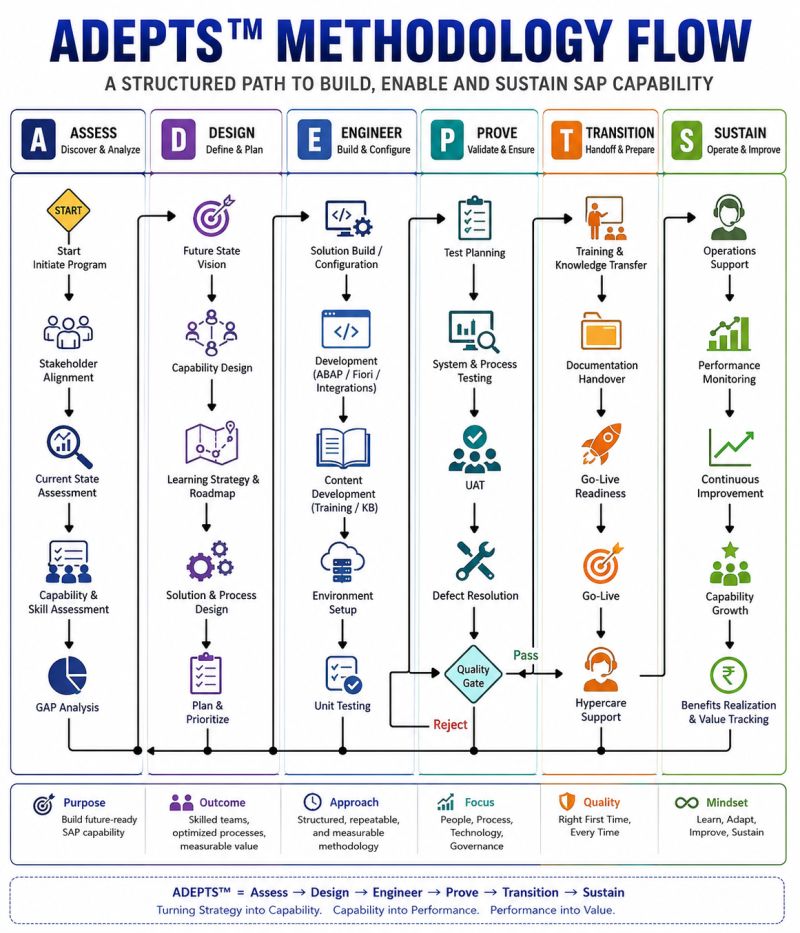
PROZIA’s Design Phase of ADEPTS™ methodology helps organizations identify and realize the SAP capabilities they need, develop those capabilities within their workforce, prove operational readiness, and build sustainable internal SAP competency—reducing transformation risk and long-term consulting dependency.