

Validate Capability & Readiness after intensive practice and before transitioning capability ownership to the business
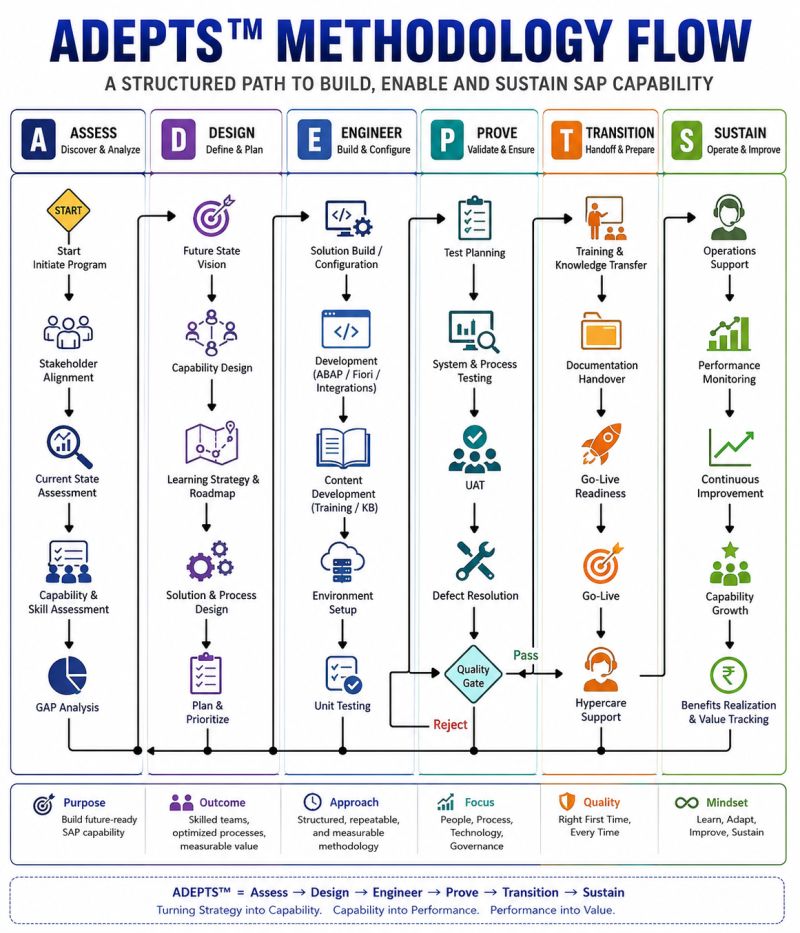
“Training completion does not equal capability. Capability must be demonstrated.”
It is not a conventional SAP training program that primarily measures attendance and course completion.
Determine whether participants can independently perform their SAP roles to the required proficiency standard and whether the organization is ready to transition from structured capability building to operational ownership.
Evidence-based capability assurance—giving leadership measurable confidence that SAP knowledge has translated into practical proficiency before Transition begins.
Through structured assessments, hands-on evaluations, role-based scenarios, and clearly defined competency benchmarks, organizations gain objective visibility into workforce readiness and remaining capability gaps.
| # | Dimension | Evaluation Criterion |
|---|---|---|
| 1 | Knowledge | Concepts and process understanding |
| 2 | System Skills | Ability to execute transactions and tasks |
| 3 | Process Competency | End-to-end business process execution |
| 4 | Problem Solving | Ability to diagnose and resolve issues |
| 5 | Configuration/Technical | Configuration, development or technical proficiency |
| 6 | Integration | Cross-module and system understanding |
| 7 | Independence | Ability to work without trainer/consultant support |
| 8 | Business Readiness | Ability to perform effectively in the live environment |
A manufacturing organization is preparing for an SAP S/4HANA go-live. Business users and key users across Procurement, Finance, Sales, and Supply Chain have completed role-based learning and hands-on practice. Before transitioning capability ownership to the business, leadership needs objective evidence that teams can execute critical business processes independently.
Although training completion rates are high, the organization needs to determine:
For example, a Procure-to-Pay team may be asked to process a procurement scenario from purchase requisition through purchase order, goods receipt, invoice verification, and payment readiness.
During execution, exceptions such as quantity or price variance—is introduced to assess whether users can identify and resolve the issue correctly.
Key users are additionally evaluated as troubleshooting, cross-functional dependencies, and their ability to support end users.
The assessment identifies that:
Targeted remediation sessions are conducted for identified capability gaps, followed by focused reassessments. Participants who meet the predefined proficiency criteria are classified as transition-ready, while remaining gaps are incorporated into individual development and support plans.
The organization enters the Transition phase with measurable evidence of workforce readiness rather than relying solely on training completion. Critical capability gaps are addressed before operational ownership is transferred, reducing go-live risk, improving user independence, strengthening internal support capability, and reducing dependency on external consultants.