

The Sustain phase ensures that the capability development does not end when training or transition is completed. It converts the capability-building initiative into an ongoing, organization-owned system for continuous learning, performance improvement, and reduced external dependency
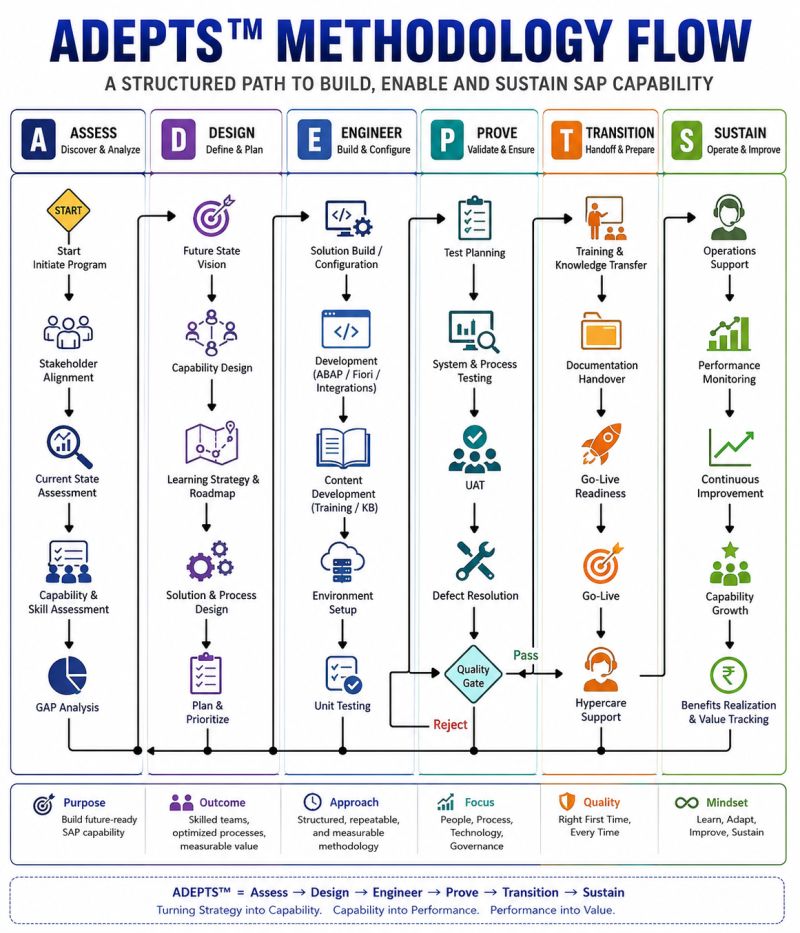
Sustain ensures that capability development becomes an organizational discipline
Tracking system usage, adoption, user feedback, and post-go-live performance is commonly recommended for understanding whether capabilities are translating into sustained adoption
SAP capabilities developed through the earlier ADEPTS™ phases remain relevant, measurable, scalable, and embedded within the organization. The transition from project-led capability building to business-as-usual capability ownership, creating an internal ecosystem that continuously develops skills as SAP processes, technologies, roles, and business requirements evolve.
SAP adoption and capability development continue beyond go-live; ongoing learning, user feedback, adoption measurement, and reinforcement help maintain proficiency and business value. Sustain is an ongoing phase.
A manufacturing organization completed an SAP S/4HANA transformation across Finance, Procurement, Sales, Manufacturing, and Supply Chain. During the ADEPTS™ engagement, approximately 150 business users, key users, and internal SAP support team members were trained and evaluated. While users achieved the required proficiency levels, leadership wanted to ensure that capabilities remained strong after the formal program ended and that dependency on external consultants continued to decline.
Sustain Approach: The organization implemented a structured capability sustainability program. A network of Super Users and SMEs was established across business functions, supported by Communities of Practice. Role-based learning paths and onboarding programs were created for new employees. Knowledge assets—including process guides, troubleshooting documentation, recorded sessions, and simulations—were maintained in a centralized repository.
Quarterly capability reviews were introduced to monitor user proficiency, SAP adoption, recurring support issues, and emerging skill gaps. Support-ticket trends and business feedback were used to identify areas requiring refresher training or targeted interventions. Advanced learning programs were introduced for high-performing employees to build the next generation of internal SAP experts.
As SAP processes and functionality evolved, learning content and competency requirements were periodically refreshed.
Illustrative Outcomes: Within 12 months, the organization could demonstrate outcomes such as higher internal resolution of SAP issues, faster onboarding of new users, sustained proficiency across critical roles, fewer recurring user errors, stronger internal SME coverage, and reduced reliance on external consultants for day-to-day support.
Business Impact: The Sustain phase transformed SAP capability development from a one-time training initiative into a continuous organizational capability. Knowledge remained within the enterprise, internal teams became increasingly self-sufficient, and the organization was better prepared to adopt future SAP innovations and business process changes.
| # | Activities | Key Outputs |
|---|---|---|
| 1 | Periodically assessing skills, proficiency levels, role readiness, and emerging capability gaps | Tracking Capability KPI, Continuous Monitoring |
| 2 | Establish refresher training, advanced learning paths, micro learning, and just-in-time learning | Continuous Learning Framework |
| 3 | Maintain and continuously update SOPs, process guides, simulations, learning assets, FAQs, and knowledge repositories | Knowledge Management |
| 4 | Build SAP functional and technical communities for peer learning and knowledge exchange | Community of Practice |
| 5 | Strengthening internal experts who can coach users, resolve common issues, and transfer knowledge | SME Network |
| 6 | Integrate role-based SAP learning paths into employee onboarding | New Joiner Enablement |
| 7 | Update learning programs for SAP upgrades, new functionalities, process changes, and transformation initiatives | Capability Updates |
| 8 | Conduct quarterly, half-yearly, or annual capability assessments against defined competency benchmarks | Periodic Assessments |
| 9 | Use assessment results, operational KPIs, support tickets, user feedback, and business changes to identify new development priorities | Continuous Improvement Plan |
Sustain ensures that capability development becomes an organizational discipline—not a one-time training intervention. By embedding continuous learning, knowledge ownership, performance measurement, and capability governance, organizations can protect their SAP investment, reduce dependency on external expertise, and continuously strengthen their internal SAP capabilities.